

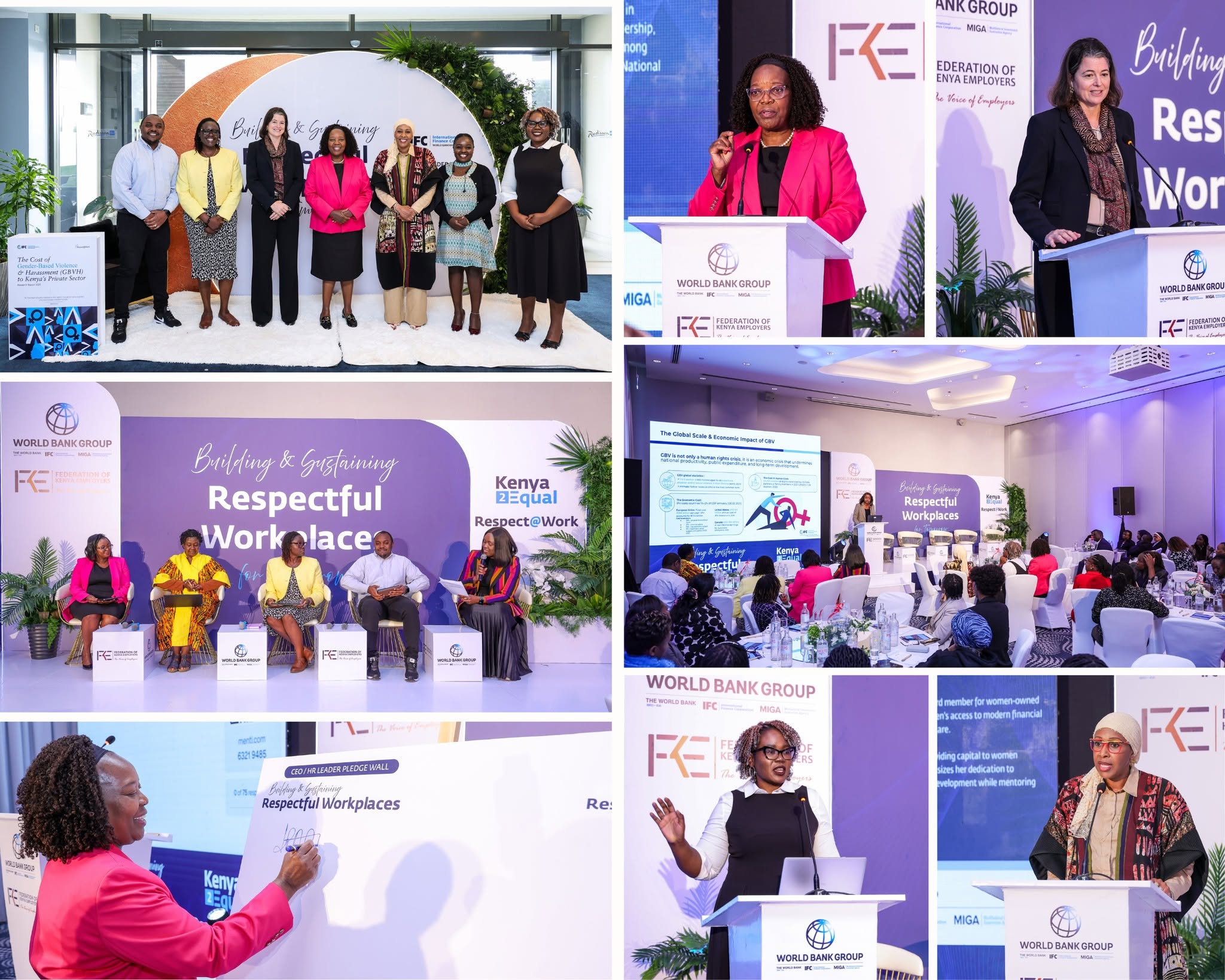
The Federation of Kenya Employers (FKE), in collaboration with the International Finance Corporation (IFC) through the Kenya2Equal Programme, convened a high-level Private Sector Forum in Nairobi to unveil and discuss the findings of a landmark report examining the economic and social impact of gender-based violence and harassment (GBVH) on Kenya’s private sector.
The forum brought together employers, development partners, labour experts and industry leaders to deliberate on strategies for creating safer and more inclusive workplaces while underscoring the business case for addressing workplace violence and harassment.
Opening the forum, FKE Executive Director and Chief Executive Officer Jacqueline Mugo called on employers to move beyond policy statements and take deliberate action to protect workers from violence and harassment.
“No one should come to earn a living and leave with a wound,” Mugo said, emphasizing that safe workplaces are not only a human rights issue but also a prerequisite for productivity and sustainable business growth. She noted that addressing GBVH is both a moral obligation and a strategic business imperative.
The discussions also featured remarks from IFC Principal Country Officer Gillian Rogers, who reaffirmed the Corporation’s commitment to supporting the private sector in promoting gender equality and building workplace environments where employees can thrive free from violence and discrimination.
Rogers said the Kenya2Equal Programme continues to work with businesses to strengthen policies and practices that foster inclusion, safety and equal opportunities for all employees.
Ms. Caroline Khamati Mugalla, Director of the International Labour Organization (ILO) for Tanzania, Burundi, Kenya, Rwanda and Uganda, highlighted the importance of ILO Convention 190, the first international treaty dedicated to eliminating violence and harassment in the world of work. She stressed that governments, employers and workers all have a shared responsibility in ensuring workplaces uphold dignity and respect.
The forum also heard the findings of the report, “The Cost of Gender-Based Violence and Harassment to Kenya’s Private Sector,” presented by IFC Global Gender-Based Violence Officer Lilian Onsongo. The study provided compelling evidence of the far-reaching human and economic consequences of GBVH, demonstrating how violence and harassment affect employee wellbeing, workplace productivity, business performance and the broader economy.
Participants further explored practical interventions during a panel discussion themed “Addressing GBVH as a Business Imperative.” Industry leaders shared experiences and best practices aimed at strengthening prevention measures, improving response mechanisms and cultivating workplace cultures founded on dignity, equality and mutual respect.
The forum culminated in a renewed call to action under the Kenya2Equal Programme, with employers urged to strengthen workplace policies, establish effective reporting mechanisms, intensify awareness initiatives and enhance leadership accountability in the fight against gender-based violence and harassment.
The commitments made at the forum underscored growing recognition within the private sector that eliminating violence and harassment is not only essential for protecting workers but is also critical to building resilient, productive and competitive enterprises.


